
Kelly Coughlin, CPA
Will AI Help or Hurt Business Owners?
Business owners are hearing about artificial intelligence everywhere.
ChatGPT. Claude. QuickBooks AI. AI accountants. Automated bookkeeping. AI agents. AI marketing tools. AI sales assistants. AI customer service bots. AI dashboards. AI everything.
And for many business owners, the natural first question is:
“What AI tool should I use?”
That is understandable.
But it is not the best starting question.
The better question is:
Will AI help me or hurt me?
The honest answer is: it depends.
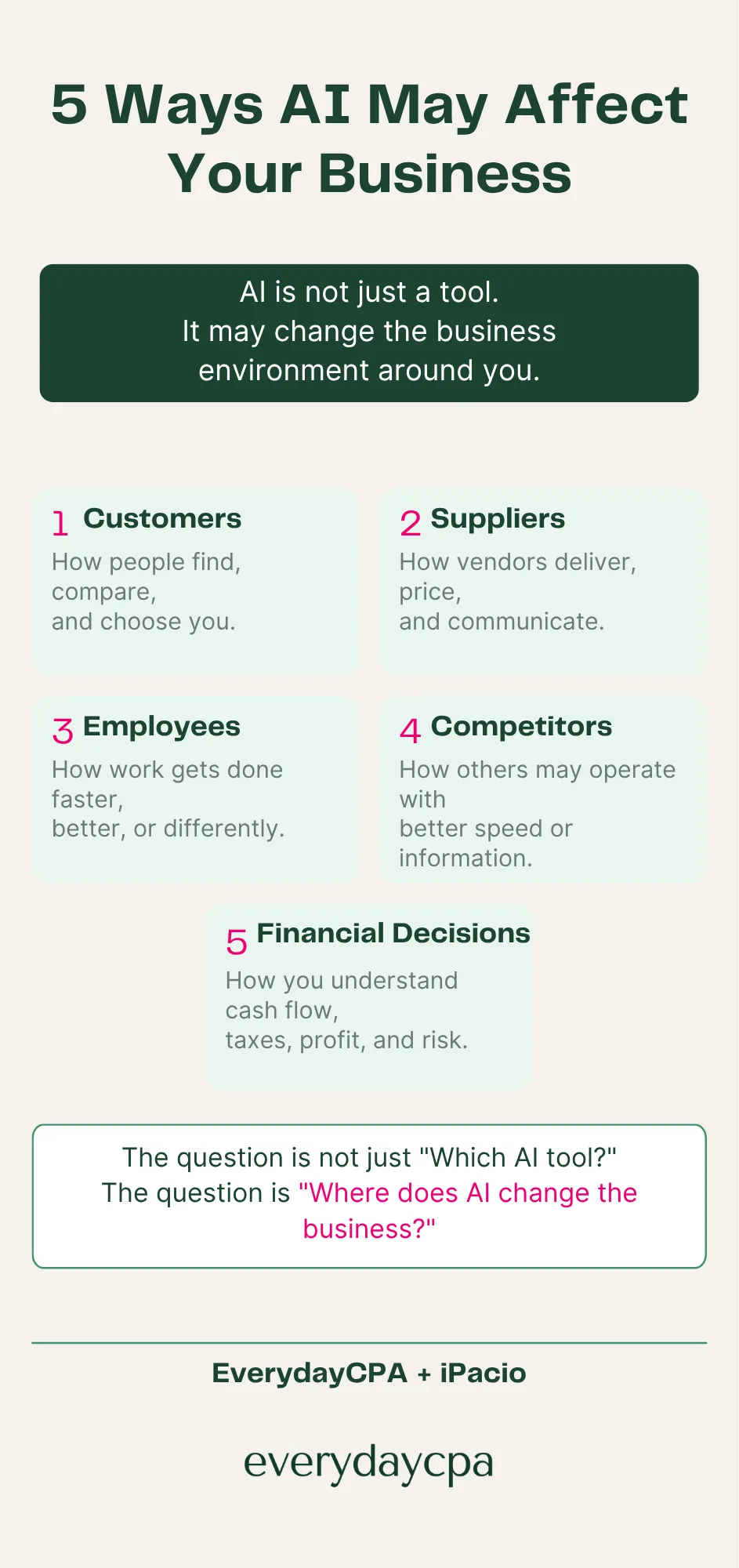
AI may affect your customers. It may affect your suppliers. It may affect your employees. It may affect your competitors. It may affect how you price, hire, communicate, market, manage cash flow, prepare taxes, and make financial decisions.
That is why AI reminds me of the Internet in the 1980s and 1990s.
Back then, business owners were not all asking, “Which website platform should I use?” At first, they were asking bigger questions:
Is this a fad?
Will customers expect me to be online?
Will competitors use this before I do?
Will it change how people find businesses?
Will it change communication?
Will it change the business model?
Today, many business owners are asking those same kinds of questions about AI.
And they should.
AI is not just another software category. It is a major shift in how information is collected, processed, organized, summarized, and used. For business owners, that matters.
But there is also a trap.
AI can make things faster.
That does not automatically make them better.
AI can produce answers.
That does not automatically make those answers correct.
AI can organize information.
That does not automatically create financial clarity.
That distinction is especially important in tax, accounting, and business finance.
As a CPA, I look at AI through a practical lens. Can it help a business owner file tax returns? Can it help manage cash flow? Can it help explain profit? Can it help create better financial information? Can it help the owner make better decisions?
The answer is yes.
But not by itself.
AI alone is not adequate. AI must be trained, structured, supervised, and reviewed by subject matter experts. Otherwise, it can create fast answers that look impressive but are incomplete, misleading, or wrong.
AI can help business owners who use it properly.
But it can hurt business owners who treat it like magic.
If AI feels important but confusing, you are not alone. The first step is not picking a tool. The first step is understanding where AI could actually help your business. Book a Call With Kelly or Cat.
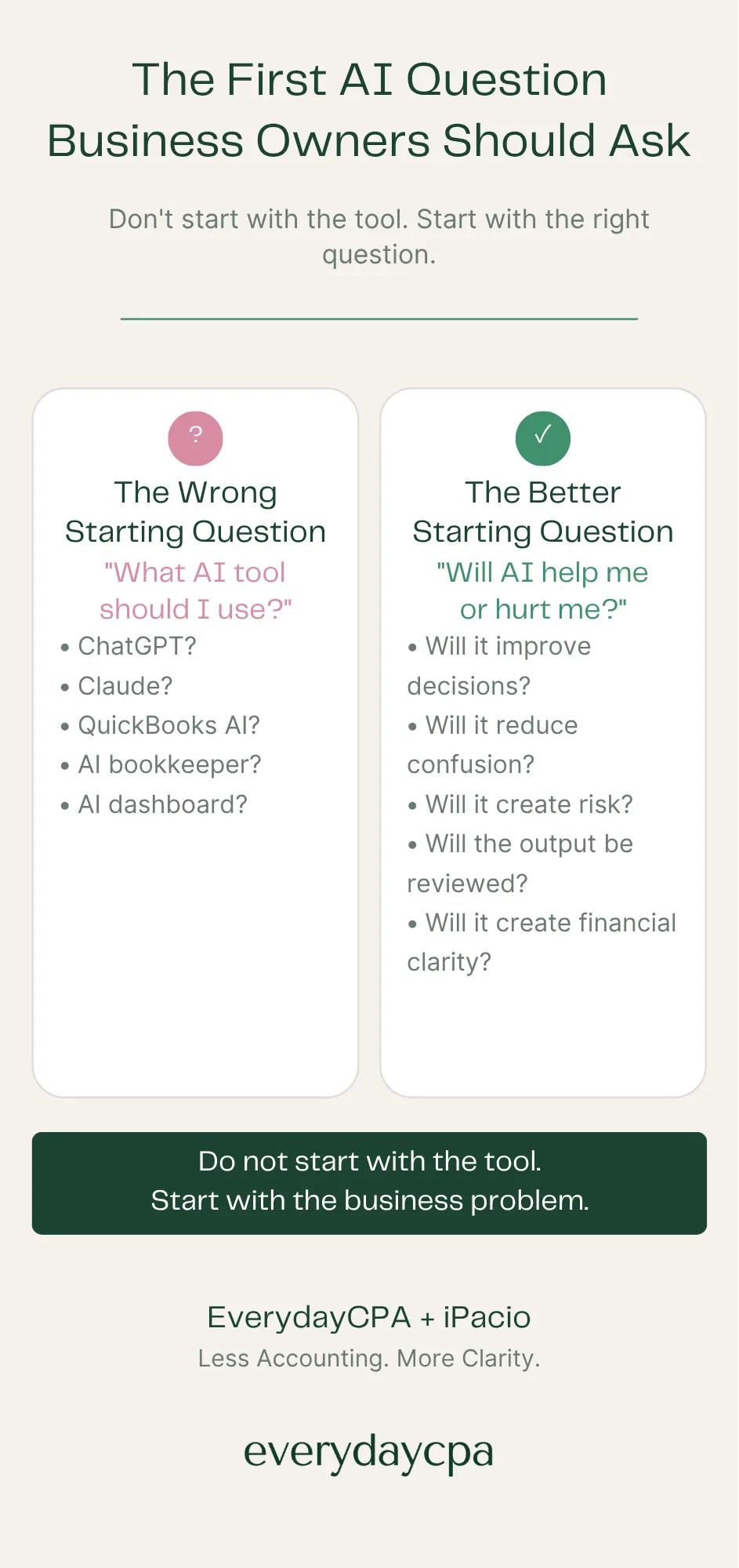
Table of Contents
Why Business Owners Are Asking the Wrong AI Question
Why AI Feels Like the Internet in the 1980s and 1990s
How AI Can Help Business Owners
How AI Can Hurt Business Owners
Why AI Alone Is Not Enough for Accounting and Tax
The Difference Between Fast Answers and Financial Clarity
What Business Owners Should Ask Before Using AI
AI, QuickBooks, and the Problem With “Automated Accounting”
The Better Model: AI Plus CPA Judgment Plus Owner Knowledge
Where iPacio Fits
What Business Owners Should Do Next
FAQ
Why Business Owners Are Asking the Wrong AI Question
Most business owners are practical.
They do not have time to study artificial intelligence as an academic topic. They want to know what matters for their company.
So when AI enters the conversation, the first instinct is usually tool-based.
Should I use ChatGPT?
Should I use Claude?
Should I use QuickBooks AI?
Should I use an AI bookkeeper?
Should I automate customer service?
Should I use AI to write emails?
Should I use AI to create reports?
Those are fair questions.
But they are not first questions.
The first question should be:
How will AI affect my business?
That question is bigger and more useful.
AI may affect how customers find you, compare you, and choose you. It may affect what your suppliers can provide, how quickly they provide it, and how much they charge. It may affect whether employees become more productive or more replaceable. It may affect whether competitors can operate faster, cheaper, or with better information.
It may also affect how you understand your own business.
That may be the most important part.
A business owner who uses AI well may get better information faster. He may understand cash flow sooner. He may identify tax issues earlier. He may find patterns in expenses, customer behavior, pricing, or operations that were previously hidden.
But a business owner who uses AI poorly may create a different problem.
He may rely on answers that sound confident but are wrong.
He may trust reports that were never reviewed.
He may automate bookkeeping mistakes.
He may believe he has clarity when he really has artificial confidence.
That is why the AI conversation should not begin with tools.
It should begin with judgment.
Why AI Feels Like the Internet in the 1980s and 1990s
When the Internet first started becoming relevant to businesses, many owners did not immediately understand how it would affect them.
Some thought it was a fad.
Some thought it only mattered for technology companies.
Some thought websites were optional.
Some thought customers would never buy online.
Some thought email was less professional than traditional communication.
Some waited.
Some experimented.
Some learned.
Some adapted early and gained an advantage.
The Internet eventually changed nearly every part of business: marketing, sales, customer service, ordering, recruiting, research, communication, pricing, competition, operations, and customer expectations.
AI may follow a similar pattern.
At first, it feels like a tool.
Then it becomes a capability.
Then it becomes an expectation.
Then it changes the way business is done.
The business owner does not need to become an AI engineer. But he does need to understand that AI may affect the business environment around him.
The question is not whether every business should use every AI tool.
The question is whether the owner understands where AI may create advantage, risk, pressure, or confusion.
That is why business owners should think about AI in five practical areas:
Customers
Suppliers
Employees
Competitors
Financial decisions
Those areas matter more than the brand name of any single AI tool.
How AI Can Help Business Owners
AI can be useful because many business problems are information problems.
Business owners are surrounded by data: bank transactions, credit card charges, invoices, payroll records, tax documents, customer messages, vendor bills, emails, contracts, reports, website activity, sales notes, and spreadsheets.
The problem is not always lack of information.
Often, the problem is that information is scattered, unorganized, inconsistent, or too time-consuming to interpret.
AI can help with that.
AI Can Help Organize Information Faster
AI can read, summarize, sort, compare, and classify information faster than people can in many situations.
For a business owner, that can be valuable.
Instead of manually reviewing hundreds of transactions, AI can help identify patterns. Instead of starting from a blank page, AI can help draft a summary. Instead of digging through disconnected data, AI can help surface possible issues.
That speed can matter.
But speed is only useful if the underlying structure is right.
A fast answer based on bad assumptions is still a bad answer.
AI Can Help Identify Patterns
AI is good at pattern recognition.
That can be useful in business finance.
It may help identify recurring expenses, unusual transactions, changes in vendor activity, cash flow patterns, revenue trends, or categories that need review.
For example, AI may notice that software subscriptions have increased steadily over six months. It may identify repeated payments to vendors that should be reviewed. It may flag deposits that look unusual compared to normal activity.
That kind of pattern recognition can help business owners see things earlier.
But AI still needs a human to ask:
Does this matter?
Is this normal?
Is this business-related?
Is this deductible?
Is this a problem?
Is this a planning opportunity?
Pattern recognition is useful.
Judgment is still required.
AI Can Help Reduce Repetitive Work
One of the best uses of AI is reducing repetitive, low-value work.
Business owners should not spend their best hours doing work that can be handled by a better system.
That is especially true in accounting.
Many owners spend too much time gathering records, explaining transactions, categorizing expenses, reviewing bank feeds, answering bookkeeping questions, or trying to make accounting software work.
AI can help reduce that burden.
It can assist with compiling, sorting, summarizing, and flagging information.
That does not mean AI should replace review.
It means AI can help move the work to the right place.
The business owner should focus on running the business.
AI can help with compilation.
CPAs and trained advisors should review, interpret, and explain what matters.
AI Can Help Improve Financial Visibility
Used properly, AI can help business owners get better visibility into what is happening.
What came in?
Where did it go?
What changed?
What looks unusual?
What might affect taxes?
What should be reviewed before year-end?
Those are practical business questions.
And those are the questions business owners care about.
They do not need more accounting jargon.
They need better visibility.
AI can help create that visibility faster, but only when the data is organized correctly and the output is reviewed by people who understand accounting, tax, and the business context.
How AI Can Hurt Business Owners
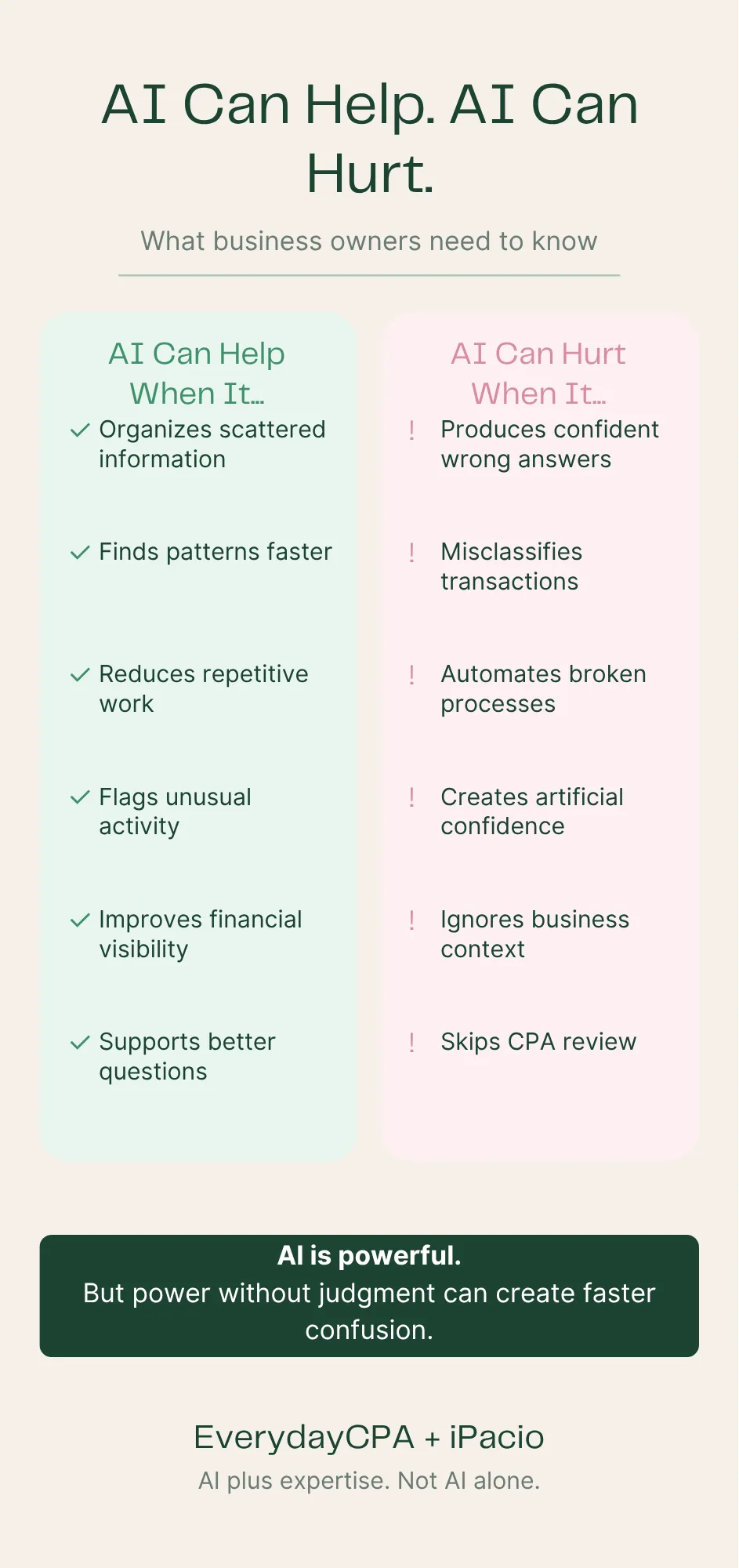
AI can hurt business owners when it creates confidence without accuracy.
That is the danger.
Business owners are busy. If an AI tool gives a fast, polished, convincing answer, it is tempting to accept it. The answer may sound professional. It may be formatted well. It may look like a report. It may even be partly right.
But partly right can still be dangerous.
AI can create fast answers, but fast answers are not always financial clarity. If your business numbers already feel confusing, let’s talk before you automate the confusion. Book a Financial Clarity Conversation.
AI Can Produce Wrong Answers That Sound Right
AI can generate answers that are confident, clear, and wrong.
That matters in accounting and tax.
A business owner may ask whether something is deductible and receive a general answer that misses the facts. He may ask how to categorize a transaction and receive an answer that ignores the entity structure. He may ask about cash flow and receive a summary that does not distinguish between profit and cash.
The answer may sound useful.
But if it is not grounded in the actual business, tax rules, documentation, and professional judgment, it may mislead the owner.
AI Can Misclassify Transactions
Transaction classification is one of the biggest accounting problems for business owners.
A deposit may be revenue.
But it may also be a loan, owner contribution, transfer, reimbursement, refund, or balance sheet item.
A payment may be deductible.
But it may also be personal, capitalized, reimbursable, loan-related, payroll-related, or subject to special tax treatment.
AI can make a guess.
But a guess is not financial clarity.
If AI misclassifies transactions at scale, the books may look clean while being wrong. That is worse than obvious messiness because the owner may not know there is a problem.
AI Can Automate Bad Processes
Automation helps when the process is good.
Automation hurts when the process is broken.
If a business has poor bookkeeping habits, inconsistent categories, unreconciled accounts, mixed business and personal activity, or weak documentation, AI may simply make the bad system move faster.
That is not progress.
That is faster confusion.
AI should not be used to hide broken processes. It should be used within a better process.
AI Can Create Artificial Confidence
Business owners do not need artificial confidence.
They need financial clarity.
Artificial confidence happens when a report looks clean, a dashboard looks impressive, or an AI answer sounds authoritative — but the underlying information has not been reviewed properly.
A beautiful dashboard can still be wrong.
A polished summary can still miss tax problems.
A fast answer can still ignore business context.
The goal is not to feel better because AI produced something quickly.
The goal is to know what is actually happening.
Why AI Alone Is Not Enough for Accounting and Tax
Accounting and tax are not just data problems.
They are judgment problems.
That is why AI alone is not enough.
AI does not automatically know your business. It does not know your entity structure, tax situation, goals, risks, history, plans, or the story behind every transaction.
It does not automatically know whether a transaction is ordinary, unusual, personal, business-related, deductible, taxable, reimbursable, misclassified, or incomplete.
It can process information quickly.
But speed is not judgment.
In accounting and tax, the difference matters.
A business owner does not just need fast numbers. He needs numbers that are organized correctly, reviewed properly, and explained in a way that helps him make better decisions.
That requires subject matter expertise.
AI must be trained with accounting logic.
It must be educated with tax rules.
It must be structured around business purpose.
It must be reviewed by people who understand what the information means.
It must be connected to the real-world knowledge of the business owner.
Without those pieces, AI may not solve the accounting problem.
It may disguise it.
The Difference Between Fast Answers and Financial Clarity
Fast answers are easy.
Financial clarity is harder.
A fast answer says:
“Here is a report.”
Financial clarity says:
“Here is what the report means.”
A fast answer says:
“This transaction looks like an expense.”
Financial clarity asks:
“What was the business purpose? Is it deductible? Is it personal? Is it capitalized? Is it properly documented?”
A fast answer says:
“Your revenue increased.”
Financial clarity asks:
“Did profit improve? Did cash improve? Did tax exposure increase? Did owner stress go down or up?”
A fast answer says:
“Your books look clean.”
Financial clarity asks:
“Are they tax-ready? Are accounts reconciled? Are transfers classified correctly? Are owner draws handled properly? Are there missing deductions? Are the reports useful for decisions?”
That is the difference.
Business owners do not need more fast answers if those answers are not reliable.
They need financial clarity.
And financial clarity requires the right combination of data, AI processing, accounting logic, tax knowledge, CPA review, and owner confirmation.
What Business Owners Should Ask Before Using AI
Business owners do not need to reject AI.
They need to use it intelligently.
Before relying on AI in your business, ask better questions.
1. What problem am I trying to solve?
Do not use AI just because it is available.
Are you trying to save time?
Improve financial reporting?
Reduce bookkeeping work?
Understand cash flow?
Plan for taxes?
Improve customer communication?
Analyze operations?
The use case matters.
AI is more useful when the problem is clearly defined.
2. What information is AI using?
AI output depends on input.
If the data is incomplete, inaccurate, or poorly organized, the answer may be unreliable.
For financial decisions, this matters a lot.
Bad data creates bad clarity.
3. Who trained the process?
In accounting and tax, AI needs subject matter expertise.
Who decided the rules?
Who reviewed the categories?
Who built the logic?
Who checks the output?
If the answer is “nobody,” be careful.
4. Who reviews the result?
AI should not be the final authority on business and tax decisions.
A trained professional should review important outputs, especially when they affect tax filing, financial reporting, cash flow, payroll, deductions, entity structure, or major business decisions.
5. What role does the business owner still play?
The owner still matters.
AI did not create the transaction. The CPA did not create the transaction. The software did not create the transaction.
The business owner created or authorized the activity.
That means the owner often has essential context.
Was the purchase business-related?
Was the deposit a sale or a transfer?
Was the payment personal or business?
Was the expense ordinary or unusual?
AI can assist, but the owner’s knowledge still matters.
AI, QuickBooks, and the Problem With “Automated Accounting”
Many business owners already feel frustrated with accounting software.
They were told QuickBooks would make things easier.
Sometimes it does.
But many owners still do not trust their reports, still fall behind, still guess at categories, and still panic at tax season.
Now AI is being added to that environment.
That can help.
Or it can make the same problem look more modern.
QuickBooks can store transactions.
AI can suggest categories.
But neither automatically creates financial clarity.
If a business owner still does not understand profitability, cash flow, taxes, owner pay, or what decisions should change, the problem is not solved.
The problem has simply moved to a new interface.
That is why “AI accounting” should not be judged by how impressive the automation looks.
It should be judged by whether the business owner gets better financial information, better tax readiness, better decisions, and less stress.
The question is not:
“Did AI produce something?”
The question is:
“Did it produce something accurate, useful, reviewed, and meaningful?”
If QuickBooks, AI, and bookkeeping tools still do not tell you what is really happening in your business, you may need a better clarity system. Talk With Kelly or Cat.
The Better Model: AI Plus CPA Judgment Plus Owner Knowledge
The future is not business owners doing all of their own accounting.
And it is not AI replacing CPAs.
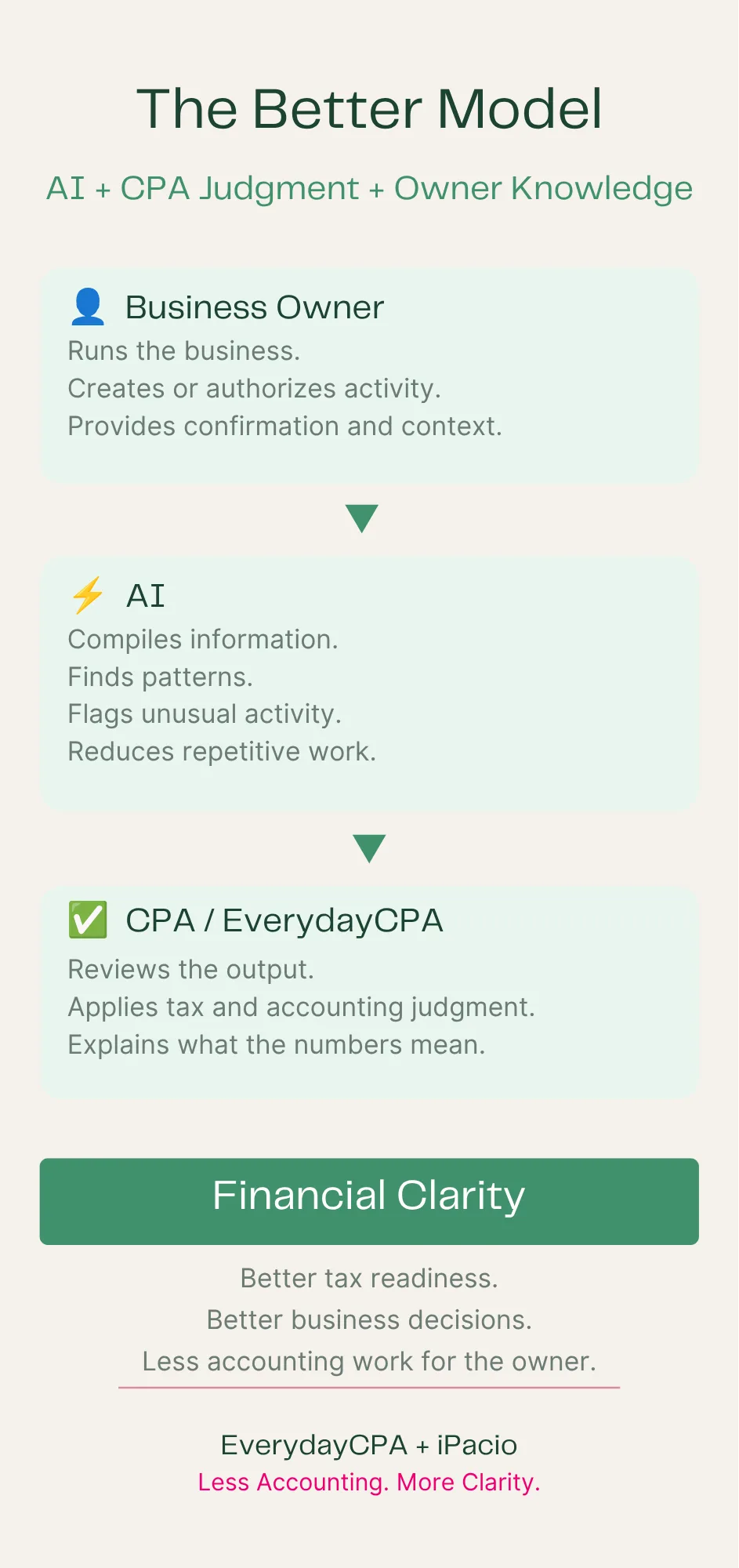
The better future is a better division of labor.
The business owner runs the business.
AI helps compile the financial activity.
Subject matter experts train and review the AI process.
The CPA provides judgment, tax knowledge, and business guidance.
The owner provides confirmation and context.
That is the model business owners actually need.
The owner should not have to become a bookkeeper.
The CPA should not spend valuable time doing repetitive data processing that AI can help reduce.
AI should not be left unsupervised to make tax and accounting decisions without professional review.
Each party has a role.
The owner authorizes the activity.
AI helps compile the information.
The CPA helps clarify what it means.
That is how business owners get better financial information faster — without pretending AI is magic.
Where iPacio Fits
At EverydayCPA, this is the idea behind iPacio.
iPacio is built around a practical belief:
Business owners should not have to become accountants to get financial clarity.
The owner still has an important role. The owner confirms transactions are real, identifies anything unusual, and provides business context when needed.
But the owner should not carry the full accounting burden.
AI can help with much of the heavy lifting. It can read transaction data, identify patterns, suggest classifications, flag unusual activity, and help organize financial information.
But AI still needs structure, training, supervision, and review.
That is where EverydayCPA comes in.
Our CPA team helps train, review, interpret, and explain the results so the business owner gets something more valuable than a fast report.
The owner gets clarity.
In practical terms, the future we see looks like this:
Most of the compilation work can be supported by AI.
A smaller but critical portion requires CPA review, judgment, and guidance.
The business owner provides confirmation and context.
That is the right division of labor.
Less accounting work for the owner.
More clarity.
Better tax readiness.
Better business decisions.
iPacio is built around a simple idea: less accounting work for the owner, more clarity for better decisions. Learn About iPacio.
Will AI Help or Hurt Business Owners?
So, will AI help or hurt business owners?
AI will probably help the business owners who learn how to use it properly.
It may hurt the business owners who ignore it, misunderstand it, or assume it magically solves problems without human judgment.
AI is not a replacement for business ownership.
It is not a replacement for professional judgment.
It is not a replacement for tax knowledge.
It is not a replacement for understanding what is actually happening inside the company.
But when AI is educated by subject matter experts, trained with accounting and tax logic, reviewed by CPAs, and confirmed by the business owner, it can help solve one of the biggest problems business owners have faced for decades:
They need better financial information, but they do not have the time, training, or desire to become accountants.
That is where AI becomes useful.
Not AI alone.
AI plus expertise.
AI plus CPA judgment.
AI plus owner knowledge.
Less accounting.
More clarity.
Better decisions.
What Business Owners Should Do Next
The next step is not to chase every AI tool.
The next step is to look at your business and ask where better information would actually help.
Do you understand your cash flow?
Do you trust your financial reports?
Do you know what your tax situation may look like before tax season?
Do you know which expenses are rising?
Do you know whether the business is truly profitable?
Do you know what decisions your numbers are pointing toward?
If the answer is no, the problem may not be that you need another app.
The problem may be that you need a better financial clarity system.
AI may be part of that system.
But it should not be the whole system.
At EverydayCPA, we believe AI is useful when it is combined with CPA judgment and owner knowledge. That is the idea behind iPacio.
If you want better financial information without becoming an accountant, book a call with Kelly or Cat.
We can help you think through where AI fits, where it does not, and how to get clearer financial information for your business.
FAQ
Will AI help or hurt business owners?
AI can help business owners when it is used with clear goals, accurate data, subject matter expertise, and human review. It can hurt business owners when they treat it like magic, rely on unreviewed answers, or use it to automate broken processes.
Can AI replace a CPA?
AI cannot fully replace a CPA. AI can process information, identify patterns, and assist with repetitive work, but CPA judgment is still needed for tax planning, financial interpretation, business context, and professional review.
Can AI do bookkeeping?
AI can assist with bookkeeping by reading transactions, identifying patterns, suggesting categories, and flagging unusual activity. But AI bookkeeping still needs proper setup, accounting logic, review, and business owner context.
Is AI good for small business accounting?
AI can be useful for business accounting when it is trained and reviewed by accounting professionals. AI alone may misclassify transactions or create reports that look clean but are not tax-ready or decision-ready.
What is the biggest risk of AI for business owners?
The biggest risk is artificial confidence. AI can produce fast, polished answers that sound right but may be incomplete, misleading, or wrong if not reviewed by someone with subject matter expertise.
How should business owners use AI?
Business owners should use AI to reduce repetitive work, organize information, identify patterns, and support better decisions. They should not rely on AI alone for tax, accounting, legal, or major financial decisions without expert review.
Why is AI not enough for tax and accounting?
Tax and accounting require judgment, context, documentation, entity-specific rules, and professional interpretation. AI can help process information, but it does not automatically know the business purpose, tax treatment, or story behind every transaction.
What is financial clarity?
Financial clarity means understanding what is happening in your business well enough to make confident decisions. It includes visibility into cash flow, profitability, taxes, expenses, risks, and next steps.
How does iPacio use AI?
iPacio is designed to use AI to help compile and organize financial activity while EverydayCPA’s CPA team reviews, interprets, and explains the results. The goal is not AI alone. The goal is AI plus CPA judgment plus owner knowledge.
Should I start using AI in my business now?
Business owners should start by identifying where AI can solve a real problem. The best starting point is not choosing a tool. It is asking where better information, faster review, or reduced repetitive work could improve decisions.
You do not need to become an accountant to use AI wisely. You need the right combination of technology, CPA judgment, and owner knowledge. Book a Call With Kelly or Cat.