
Kelly Coughlin, CPA
The Growth Trap: Why Profitable Businesses Run Out of Cash

Sales are climbing. Customers want more. The profit and loss statement shows a healthy bottom line.
So why does payroll still feel tight?
Why are credit card balances rising? Why are you delaying your own pay? And why does every new customer seem to create more financial pressure instead of less?
This is the growth trap.
A profitable business can run out of cash when it must spend money to deliver its work before it collects from customers. The faster the business grows, the more money it may need to advance for labor, inventory, equipment, contractors, taxes, and overhead.
Growth is not necessarily the problem. Unfunded growth is.
Understanding that difference can help you protect a good business from a preventable cash crisis.
Profit Is Not the Same as Cash
Profit measures economic performance over a period. Cash measures the money that is actually available to pay obligations today.
Those numbers are related, but they are not interchangeable.
The SEC explains the distinction this way: an income statement shows whether a company earned a profit, while a cash flow statement shows whether it generated cash.
Under accrual accounting, revenue may appear on your profit and loss statement when you earn it, even if the customer will not pay for another 30, 60, or 90 days. Expenses may also appear at a different time from the related cash payment.
That timing difference creates a dangerous illusion:
The business can record profit before it receives the money needed to survive.
Your employees, vendors, lender, and tax agencies do not accept accounting profit as payment. They require cash.
A Simple Example of the Growth Trap
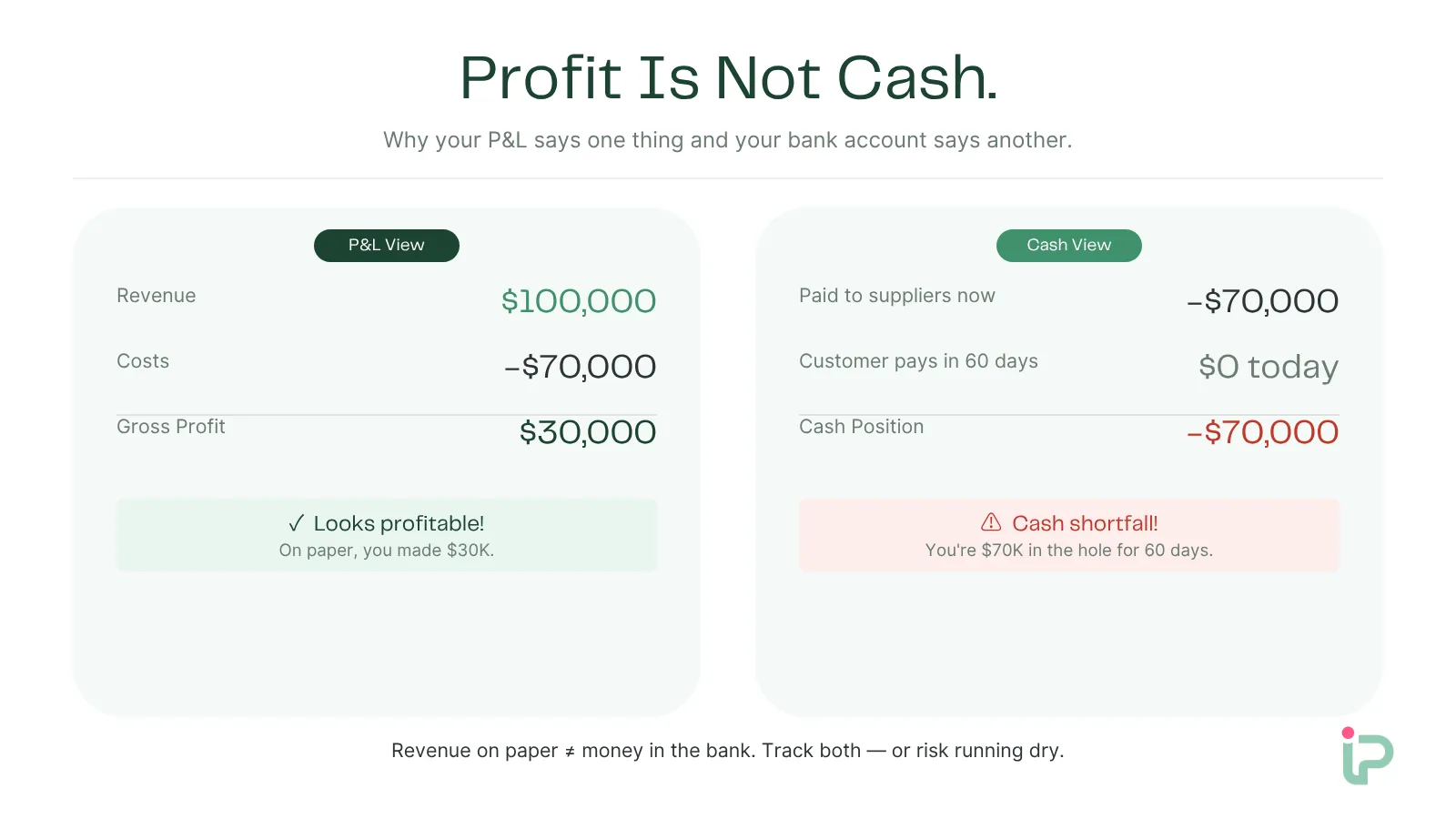
Imagine a contractor wins a $100,000 project.
The project has $70,000 in labor, materials, and subcontractor costs. That leaves a projected gross profit of $30,000.
On paper, it looks like a good job.
But the contractor must pay most of the $70,000 during the next four weeks. The customer will not pay the invoice for 60 days.
The company therefore needs as much as $70,000 in cash before collecting the first dollar from the customer.
Now imagine that the contractor wins a second similar project the following month. The business may need another $70,000 before the first project is collected.
The company has $60,000 in projected gross profit across two jobs. It may also need to fund $140,000 of cash costs before the receivables arrive.
Winning more work has made the business look more successful. It has also increased the amount of cash at risk.
This hypothetical example leaves out overhead, payroll taxes, loan payments, owner compensation, and unexpected delays. In the real world, the need can be even greater.

Where Did the Profit Go?
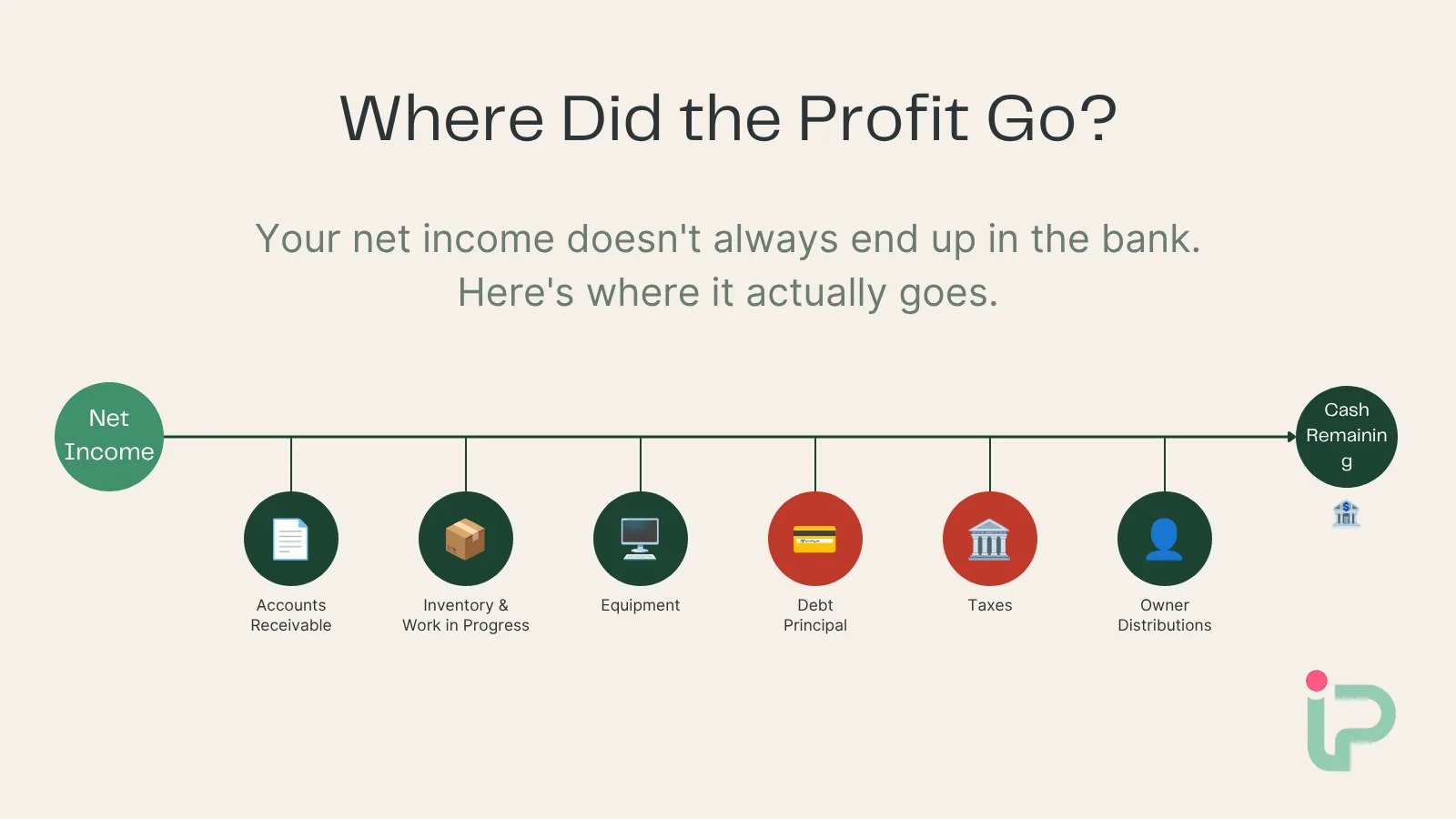
When business owners ask, “If we made a profit, where is the money?” the answer is usually visible across the balance sheet and cash flow statement.
1. Customers Have Not Paid Yet
Accounts receivable represents sales you have recorded but not collected.
The revenue may be on your P&L. The profit may be real. But until the customer pays, the cash is still sitting in someone else’s bank account.
Growth makes this worse because each new sale may add another invoice to receivables. If monthly sales rise from $100,000 to $200,000 while customers continue paying in 60 days, the business may have to finance roughly twice as much work.
This is why slow invoicing, vague payment terms, billing disputes, and weak collection habits are not merely administrative problems. They are financing decisions.
2. Cash Is Sitting in Inventory or Work in Progress
Inventory is an asset, not an immediate expense. Buying more inventory therefore reduces cash without reducing profit by the same amount at that moment.
The same problem appears in work in progress. A contractor, manufacturer, or agency may invest weeks of labor and materials before a project reaches a billable milestone.
The business has created value, but that value cannot yet pay rent or payroll.
3. Growth Requires Hiring Before Revenue Arrives
A new employee may need a computer, training, benefits, payroll taxes, management time, and several paychecks before producing enough billable work or new revenue.
The hire may be strategically correct. The business may eventually become more profitable.
But “eventually” is not a cash-flow plan.
Before hiring, owners need to understand the full cost, expected ramp-up period, revenue capacity, and cash runway. Everyday CPA’s guide to financial clarity for small business owners explains why hiring decisions require more than a quick look at revenue or the current bank balance.
4. Equipment Uses Cash Faster Than It Hits the P&L
Suppose a business pays cash for a $60,000 vehicle or piece of equipment.
The bank balance may fall by the full $60,000 immediately. For accounting and tax purposes, however, the asset’s cost may be recognized over time through depreciation, subject to applicable rules and elections.
That means the P&L may show only part of the economic cost while the cash has already left.
The equipment may be a smart investment. The problem is using short-term operating cash to fund a long-term asset without first testing the effect on liquidity.
5. Loan Principal Does Not Reduce Profit
Loan payments often contain both interest and principal.
Interest is generally reflected as an expense. Principal repayment reduces the loan balance on the balance sheet, but it does not appear as an expense on the P&L.
A company can therefore report a profit while sending substantial cash to lenders every month.
Looking only at net income can hide the burden of debt repayment.
6. Taxes Were Earned but Not Reserved
A profitable month may create a tax obligation without automatically moving cash into a tax account.
The IRS describes federal income tax as a pay-as-you-go system. Depending on entity type and circumstances, owners or businesses may need estimated payments during the year. Employers also have separate payroll tax deposit obligations.
If every deposit is treated as spendable cash, the business may appear comfortable until a tax deadline arrives.
A tax reserve does not eliminate the tax. It makes the obligation visible before the due date.
7. Owner Draws and Distributions Reduce Cash
Owner draws and many distributions are not operating expenses on the P&L.
That means a company can report $150,000 of profit, distribute much of its available cash, and then struggle to fund growth or taxes.
Owners deserve to be paid. But compensation, distributions, taxes, debt payments, and business reinvestment must be planned together.
Otherwise, the business may produce accounting profit without retaining the cash needed for stability.
Why Fast Growth Magnifies the Problem
A stable business can sometimes absorb inefficient payment terms or loose financial habits. A rapidly growing business has less room for error.
Growth increases the number of customers to bill, employees to pay, products to stock, vendors to manage, and mistakes to correct. It also increases the cash tied up between paying for work and collecting from customers.
That interval is often measured through the cash conversion cycle:
Inventory days + receivable days − payable days = cash conversion cycle
In plain English, the calculation estimates how long company cash is committed before returning through customer payments. BDC’s working-capital guidance explains that a longer cycle locks up funds and that growing companies may need to finance receivables while waiting for collection.
The exact calculation varies by business model. A consulting firm may have little inventory but significant receivables and payroll. A retailer may pay for inventory months before a sale. A contractor may face deposits, retainage, change orders, and milestone billing.
The underlying question is the same:
How much cash must leave before the cash from a sale comes back?
If you do not know the answer, you do not yet know how much growth the company can afford.
The Three-Statement View Every Growing Business Needs
A P&L alone cannot explain the health of a growing company.
You need three connected views:
Profit and Loss Statement
The P&L shows revenue, expenses, and profit over a period. Use it to monitor margins, overhead, pricing, and operating performance.
Balance Sheet
The balance sheet shows what the business owns and owes at a point in time. It reveals whether cash is accumulating in receivables, inventory, equipment, or other assets—and whether debt and short-term obligations are rising.
Cash Flow Statement and Forecast
The cash flow statement explains where cash came from and where it went. A forward-looking forecast helps you see what may happen next.
Software can generate these reports, but reports alone do not create understanding. As Everyday CPA explains in its guide to AI bookkeeping for small business, organized data still needs accurate accounting, professional review, and business context.
Warning Signs That Growth Is Becoming a Cash Trap
Watch for these patterns:
Revenue and profit are rising, but the bank balance is falling.
Accounts receivable grows faster than sales.
Customers regularly pay beyond agreed terms.
Inventory is increasing faster than cost of sales.
Payroll depends on the next large customer payment.
Credit cards or merchant advances are covering ordinary operating costs.
Tax money is being used for payroll, inventory, or expansion.
Owner pay becomes inconsistent despite reported profit.
New projects have good margins but require large cash advances.
The business cannot explain the difference between net income and the change in cash.
One warning sign does not automatically mean the business is failing. It means the timing deserves attention.

How to Escape the Growth Trap
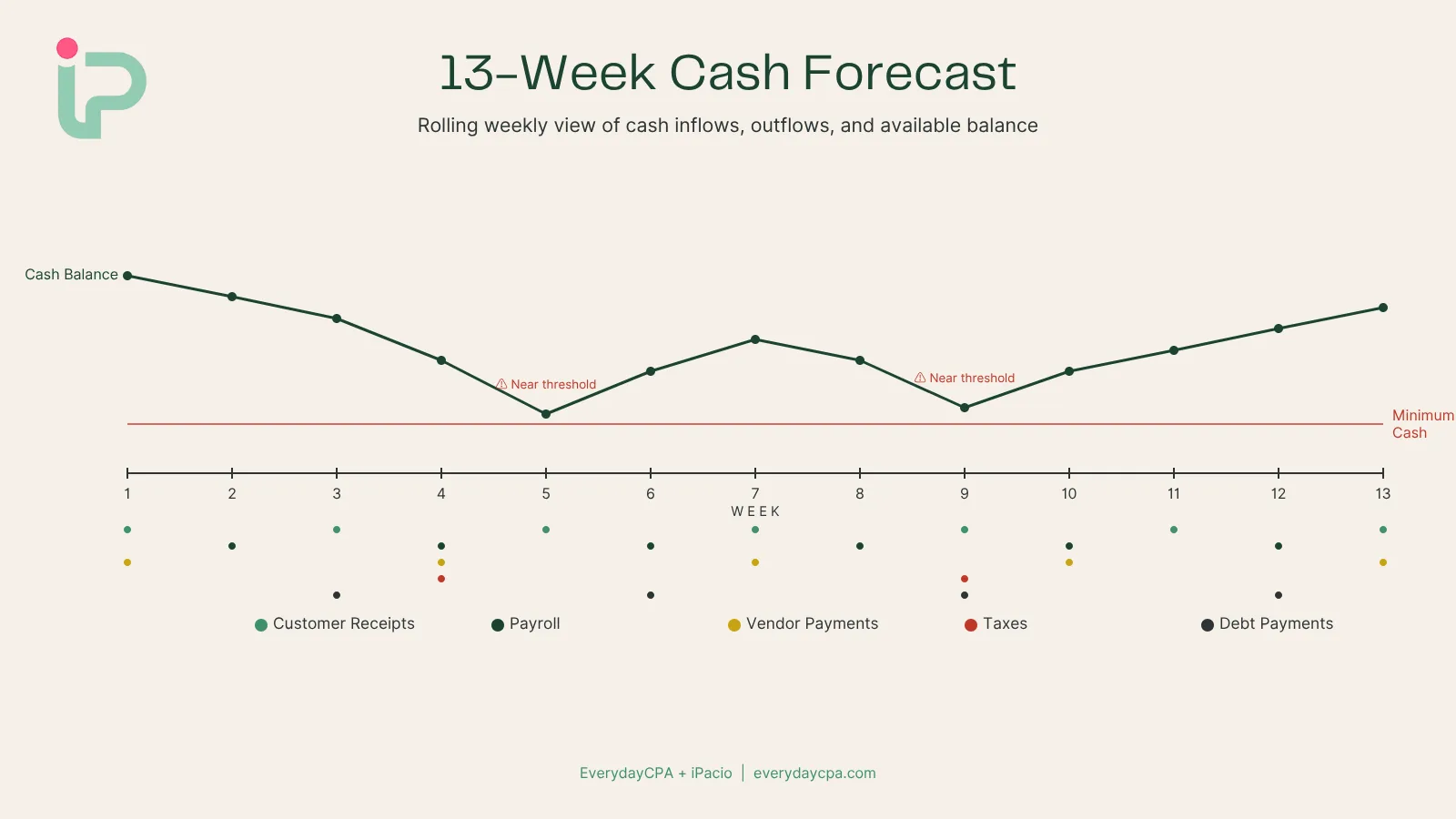
1. Build a Rolling 13-Week Cash Forecast
A 13-week forecast is short enough to estimate with reasonable detail and long enough to reveal payroll cycles, rent, tax dates, debt payments, major purchases, and expected collections.
Deloitte recommends a weekly 13-week direct cash forecast as a tool for transparency and accountability.
At minimum, forecast:
Beginning cash
Expected customer receipts by week
Payroll and payroll taxes
Vendor and contractor payments
Rent, debt, insurance, and subscriptions
Estimated tax payments
Equipment or inventory purchases
Owner compensation and distributions
Minimum ending cash
Update it weekly. Compare expected numbers with actual results. The differences will teach you where your assumptions are weak.
2. Create a Monthly Profit-to-Cash Bridge
Start with net income. Then identify the cash effect of:
Changes in accounts receivable
Changes in inventory or work in progress
Changes in accounts payable
Equipment purchases
Loan proceeds and principal payments
Tax payments
Owner draws or distributions
This bridge answers the owner’s real question: “Where did the profit go?”
3. Shorten the Time Between Work and Payment
Send invoices as soon as the billing condition is met. Use clear terms. Request deposits or progress payments when appropriate. Resolve disputes quickly. Assign responsibility for collections.
For recurring services, consider automatic payment or advance billing where the commercial arrangement permits it.
The goal is not aggressive collection. It is eliminating unnecessary delay.
4. Protect Margin While You Grow
More sales will not rescue weak unit economics.
Review profitability by customer, service, product, or job. Include direct labor, payroll burden, subcontractors, materials, commissions, discounts, rework, and other delivery costs.
If a project earns too little margin or ties up cash for too long, growth may amplify the damage.
5. Separate Cash Into Clear Purposes
Consider creating operating, payroll, and tax reserve accounts where appropriate. Establish a minimum operating-cash target based on the company’s volatility and obligations.
Separate accounts do not replace forecasting, but they can make commitments harder to ignore.
6. Match Financing to the Need
A revolving line of credit may help bridge a temporary receivables cycle. A term loan may be more suitable for long-lived equipment. Retained earnings may fund measured expansion without new debt.
High-cost financing used to cover a recurring operating deficit can deepen the problem. The Federal Reserve has noted that online-lender applicants frequently report challenges involving high rates and unfavorable repayment terms in its review of small-business financing.
Financing should support a sound cash cycle, not disguise an unprofitable model.
7. Establish Growth Gates
Before approving a major hire, contract, customer, inventory order, or expansion, ask:
What cash must we spend before collecting?
When will we invoice?
When do we realistically expect payment?
What happens if payment is 30 days late?
What margin remains after all delivery costs?
What taxes will the additional profit create?
How much minimum cash must remain?
Does the 13-week forecast stay above that minimum?
A large sale is not automatically a good sale. A good sale has acceptable margin, workable terms, manageable risk, and a cash plan.
Growth Should Make the Business Stronger
The answer is not to stop growing.
The answer is to stop treating revenue, profit, and cash as if they were the same number.
A growing business needs clean books, a trustworthy balance sheet, realistic cash forecasting, tax awareness, and decisions tied to actual capacity. It does not need another dashboard that displays numbers without explaining them.
This is the kind of financial clarity Everyday CPA is built to provide. Through CPA guidance and tools such as iPacio, the goal is to help owners understand what the numbers mean without forcing them to become bookkeepers.
If your business is profitable but cash keeps getting tighter, do not wait for the next payroll or tax deadline to confirm the problem. Book a conversation with Kelly or Cat and start tracing where the cash is going.
This article is for general educational purposes and does not constitute personalized accounting, tax, legal, lending, or financial advice. Cash requirements and tax obligations depend on your entity, industry, jurisdiction, contracts, and specific circumstances.

Frequently Asked Questions
Can a profitable business still go bankrupt?
Yes. A profitable company can face a liquidity crisis if it cannot produce enough cash to meet obligations when they are due. Formal bankruptcy and insolvency have specific legal meanings, but ordinary cash shortages can become serious long before either occurs.
Why does growth consume cash?
Growth often requires labor, inventory, materials, equipment, and overhead before customers pay. The larger the sales volume, the more working capital the company may need to finance that timing gap.
Where is my profit if it is not in the bank?
It may be in accounts receivable, inventory, work in progress, equipment, debt principal payments, tax payments, or owner distributions. A profit-to-cash bridge can identify the exact causes.
How much working capital does a growing business need?
There is no universal percentage. The answer depends on margins, customer payment speed, inventory needs, supplier terms, payroll timing, seasonality, debt obligations, and growth rate. A 13-week forecast and cash conversion analysis provide a better estimate than a generic benchmark.
Is a line of credit the solution?
It can be useful for predictable, temporary working-capital timing gaps. It is not a cure for consistently weak margins, uncollectible receivables, uncontrolled spending, or an operating model that consumes more cash than it produces