
Cat Glass, CPA
The Vital 5: Monthly Financial Metrics That Matter

Your accounting software can generate dozens of reports before your coffee gets cold. That does not mean you know what to do next.
For many business owners, a monthly financial review turns into one of two things: a quick glance at the bank balance or a long scroll through a profit-and-loss statement that raises more questions than it answers. Neither creates much confidence. One number is too narrow. Thirty reports are too much.
What you need is a short, repeatable view of the business: Are sales moving in the right direction? Are you keeping enough of each dollar? Is profit turning into cash? Are customers paying? And is the business leaving room for taxes and near-term obligations?
That is the purpose of the Vital 5. These financial metrics for small business do not replace accurate books, a balance sheet, or professional advice. They give you a practical dashboard for deciding where to look, what to ask, and what to do next.
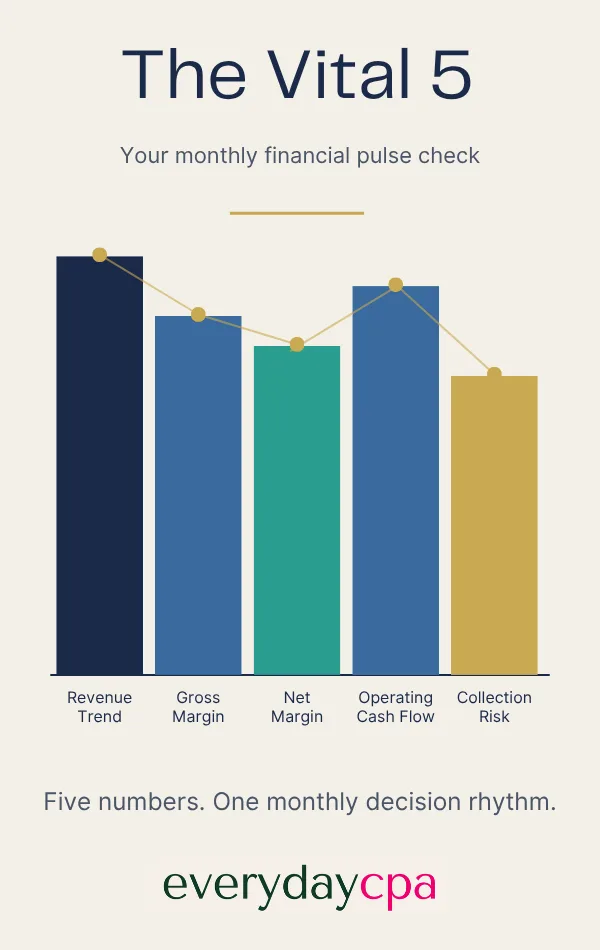
The Vital 5: revenue trend, gross profit margin, net profit margin, operating cash flow, and accounts receivable aging. Review them together, because no single number tells the whole story.
Why a Monthly Financial Review Beats a Bigger Report Pack
Financial statements answer different questions. An income statement shows revenue, costs, and profit over a period. A balance sheet shows what the business owns and owes at a point in time. A cash flow statement shows how cash moved. As the SEC’s plain-English guide explains, these statements are related, but they are not interchangeable. A profitable month can still drain cash. A healthy bank balance can hide unpaid taxes, credit-card debt, or customer deposits you have not earned yet.
A useful monthly review does three jobs:
Compresses the financial picture into a handful of decision signals.
Compares those signals with a meaningful baseline, not an isolated month.
Ends with an action, an owner, and a date to check the result.
Monthly is a practical rhythm for many small businesses because it is frequent enough to catch a pattern before a quarter disappears, but not so frequent that normal daily noise takes over. A business with tight cash, high transaction volume, or fast inventory cycles may also need weekly cash checks. Monthly remains the deeper interpretation point.

Before You Trust the Five, Trust the Inputs
A dashboard built on unreconciled accounts is only a cleaner-looking guess. Before the review, confirm that bank and credit-card accounts are reconciled, payroll and loan activity are posted, major sales and expenses are in the correct period, and personal transactions are not distorting the picture. The IRS notes that a recordkeeping system should clearly show business income and expenses; clean records also support financial statements and tax reporting.
If your books are behind, start there. This is not a character flaw. It is a data problem, and it is fixable. Everyday CPA’s guide to financial clarity explains why organized data and clean bookkeeping are the foundation, not the finish line.
Vital Number 1: Revenue Trend
Revenue is the top line: the sales your business earned during the period under your accounting method. It tells you whether demand and sales activity are expanding, holding, or shrinking. It does not tell you whether those sales were profitable or collected in cash.
How to calculate it
Revenue growth % = (current-period revenue − comparison-period revenue) ÷ comparison-period revenue × 100
Do not compare only with last month. If the business is seasonal, compare with the same month last year. Also compare year to date with the same year-to-date period and, if you use a plan, with budget. A 20% jump after the slowest month of the year may be ordinary. A 5% decline during your traditional peak may deserve attention.
Questions to ask
Did growth come from more customers, higher prices, larger orders, or one unusually large job?
Is the revenue recurring, contracted, or likely to repeat?
Did discounts, refunds, or unbilled work change the quality of the top line?
Did revenue growth require costs that rose even faster?
Decision signal: Use revenue trend to investigate demand and concentration. Never use it alone as proof that the business is healthier.
Vital Number 2: Gross Profit Margin
Gross profit is revenue minus the direct costs required to deliver the product or service. Gross profit margin converts that dollar amount into a percentage, making it easier to compare periods of different sizes.
How to calculate it
Gross profit margin = (revenue − direct costs) ÷ revenue × 100
If revenue is $100,000 and direct costs are $42,000, gross profit is $58,000 and gross margin is 58%. The classification of direct costs must be consistent. A contractor may include materials and subcontractors. A service firm may include delivery labor. A retailer will focus on cost of goods sold. If those categories move around each month, the trend stops meaning what you think it means.
Questions to ask
Did pricing keep pace with labor, materials, merchant fees, or subcontractor costs?
Did the mix shift toward lower-margin products, clients, or jobs?
Are rework, rush shipping, overtime, or scope creep quietly becoming direct costs?
Is one service line subsidizing another?
Decision signal: A falling gross margin often points toward pricing, purchasing, delivery efficiency, or product mix. More sales will not automatically fix a weak unit economic model.
Vital Number 3: Net Profit Margin
Net profit shows what remains after the business records its operating expenses and other applicable expenses for the period. Net profit margin shows how much of each revenue dollar reaches the bottom line.
How to calculate it
Net profit margin = net profit ÷ revenue × 100
If the same $100,000 business reports $12,000 of net profit, its net margin is 12%. That number needs context. Owner compensation, debt interest, depreciation, entity structure, one-time expenses, and the accounting method can all affect the result. Compare the same definition over time and ask a CPA how owner pay and taxes should be interpreted for your structure.
Questions to ask
Did overhead rise faster than gross profit?
Which expense changes are intentional investments, and which are drift?
Is the owner being compensated in a way that makes the reported margin look artificially high or low?
Is the profit sufficient to support taxes, debt service, reinvestment, reserves, and the owner’s goals?
Decision signal: Gross margin tells you whether delivery economics work. Net margin tells you whether the whole business model works after overhead. Track both; they diagnose different layers.
Vital Number 4: Operating Cash Flow
Profit is an accounting result. Cash flow tracks actual cash movement. The SEC describes cash flow from operating activities as the cash generated or used by day-to-day business activity after adjusting for noncash items and changes in working capital. That distinction is why a profitable company can still feel cash-poor.
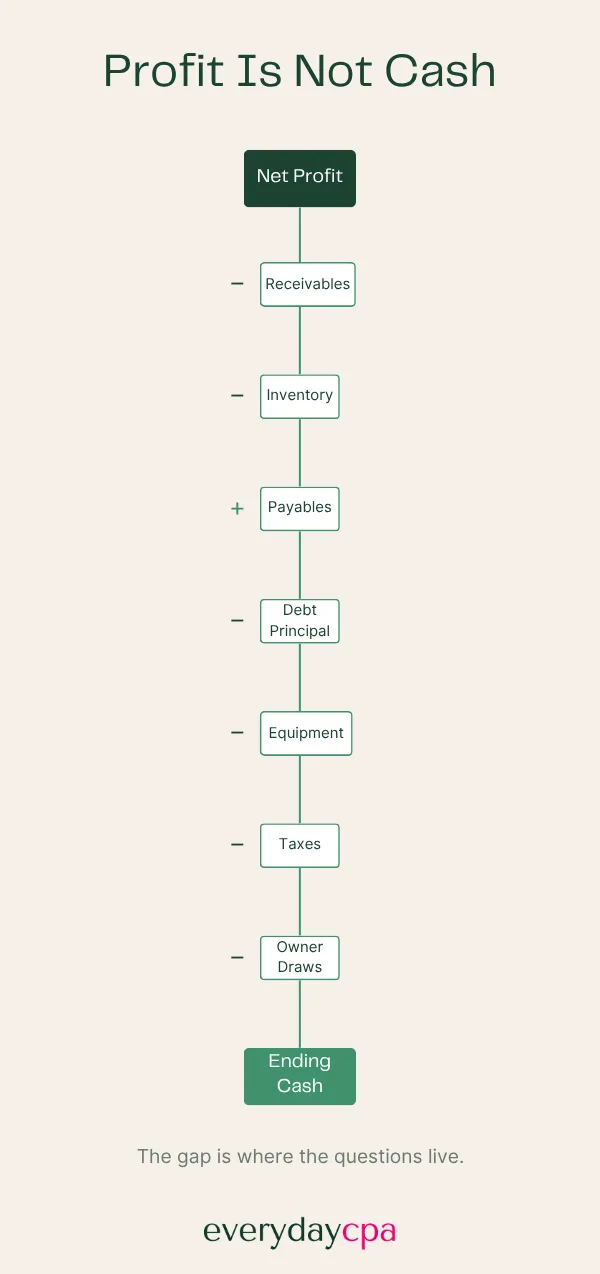
A formal cash flow statement is best when it is reliable. For a simple owner dashboard, show operating cash flow for the month and the ending unrestricted cash balance. Then list large obligations due soon: payroll, sales or payroll taxes, estimated taxes, debt payments, major vendor bills, and committed purchases.
Questions to ask
Did operations generate cash, or did borrowing and owner contributions make the bank balance look healthy?
Did receivables or inventory absorb cash even though the P&L showed profit?
Are loan principal payments, equipment purchases, or owner draws explaining the gap?
How many weeks or months of essential outflows could available cash cover?
Decision signal: Negative operating cash flow is not automatically a crisis, especially during planned growth or seasonality. Repeated negative operating cash flow without a funded plan is a warning. Read the cause before choosing the cure.
Vital Number 5: Accounts Receivable Aging
Revenue does not pay payroll until the money arrives. Accounts receivable aging shows what customers owe and how long invoices have been outstanding. A practical dashboard can show total receivables, the amount more than 30 days old, the amount more than 60 or 90 days old, and how much is concentrated in the largest customer.
A simple collection-risk view
Past-due percentage = past-due receivables ÷ total accounts receivable × 100
If receivables total $25,000 and $10,000 is past due, the past-due percentage is 40%. That does not prove the invoices are uncollectible, but it tells you where cash is stuck and which conversations cannot wait.
Questions to ask
Which invoices need a reminder, a phone call, a payment plan, or a dispute resolution?
Are payment terms clear and enforced consistently?
Can deposits, milestone billing, card-on-file, or faster invoicing shorten the collection cycle?
Would losing or delaying one large customer create a cash problem?
Decision signal: Treat aging as an operating process, not merely a bookkeeping report. The action usually belongs to invoicing, customer communication, contracts, or payment methods.

What If Your Business Has Little or No Accounts Receivable?
A cash-at-sale retailer, restaurant, or subscription business may have almost no receivables. Keep the framework at five by replacing the fifth metric with the working-capital signal that controls cash in your model:
Inventory business: inventory turnover, slow-moving inventory, or weeks of stock on hand.
Subscription business: recurring revenue, churn, or failed-payment rate.
Project business: signed backlog, unbilled work, retainage, or job-level margin.
Cash business: accounts payable due, vendor terms, or labor cost as a percentage of revenue.
The rule is simple: the fifth number should expose the delay or bottleneck between doing the work and keeping the cash.
Read the Five as a Story, Not Five Grades
Imagine a service business with the following month:
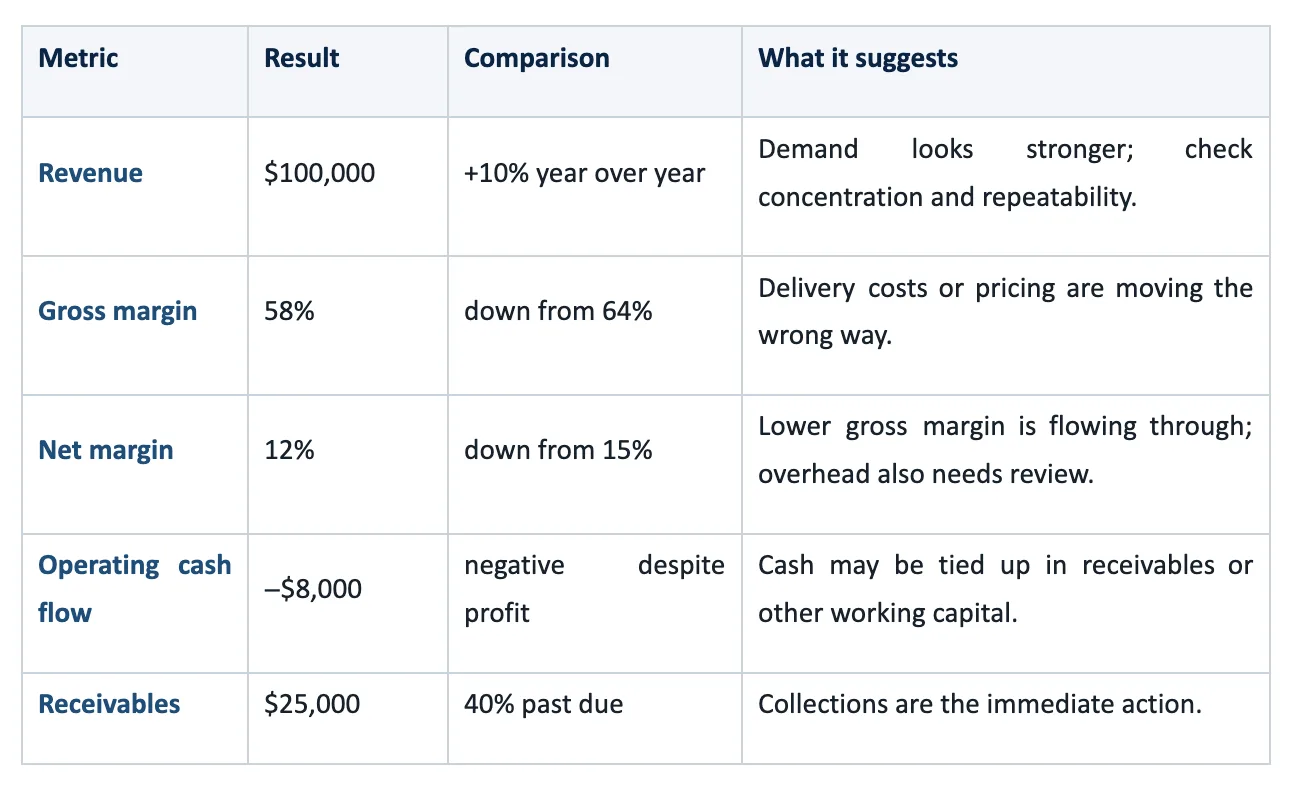
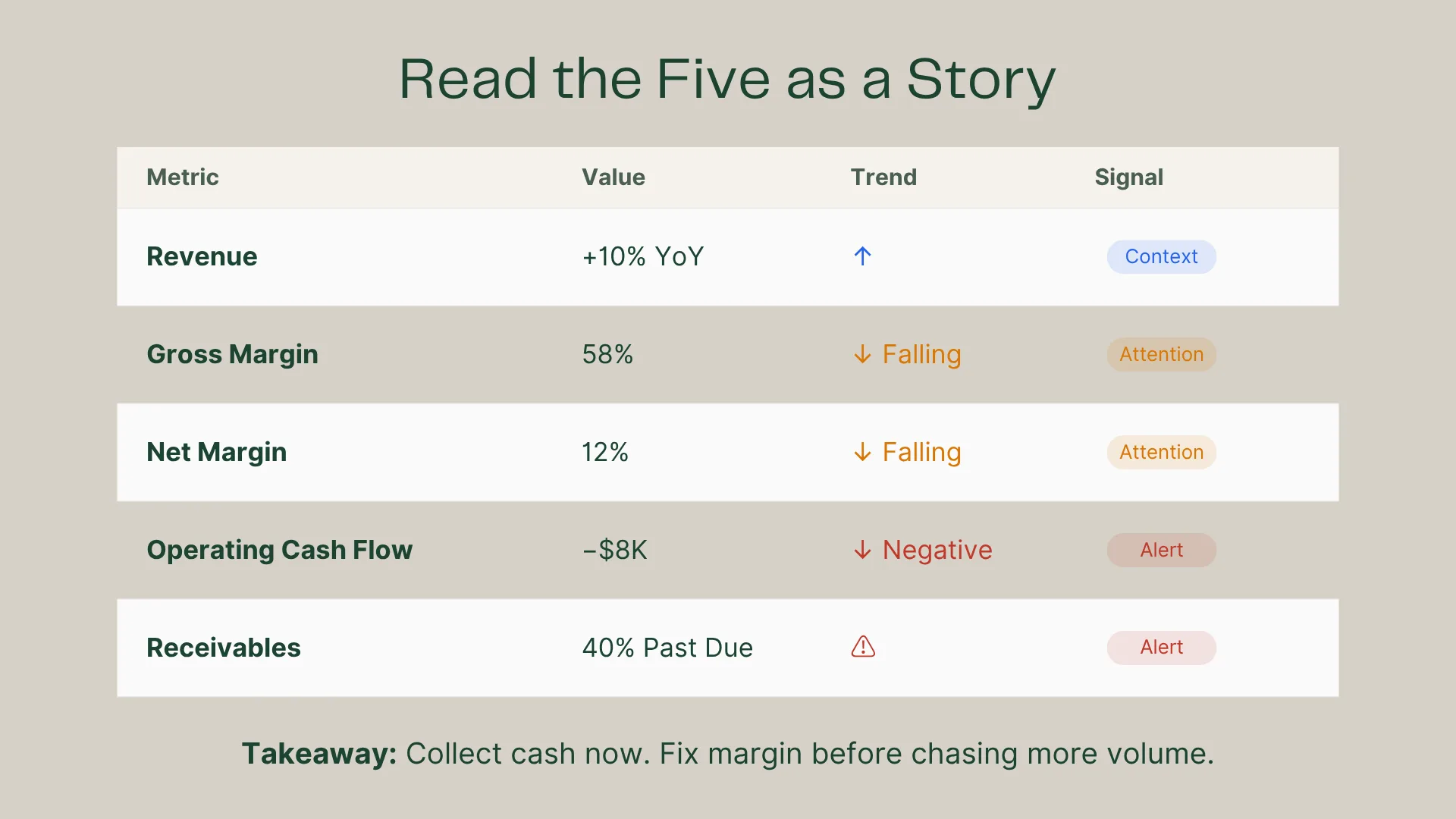
Revenue alone says, ‘Good month.’ The Vital 5 says, ‘Demand grew, but we kept less of each dollar and did not collect enough cash. Fix collections now, then investigate pricing or direct-cost creep before chasing more volume.’ That is financial clarity: the numbers become a decision.
Use Three Comparisons Every Month
A number without a comparison has very little meaning. For each Vital 5 metric, show:
Current month versus prior month, to spot recent movement.
Current month versus the same month last year, to control for seasonality.
Year to date versus prior year or budget, to see whether the broader plan is holding.
If your business changes quickly, add a rolling three-month average. It smooths one-time spikes without hiding the direction. When benchmarking against other companies, use the closest available industry, size, geography, and accounting definitions. A universal ‘good margin’ copied from the internet can be worse than no benchmark at all.
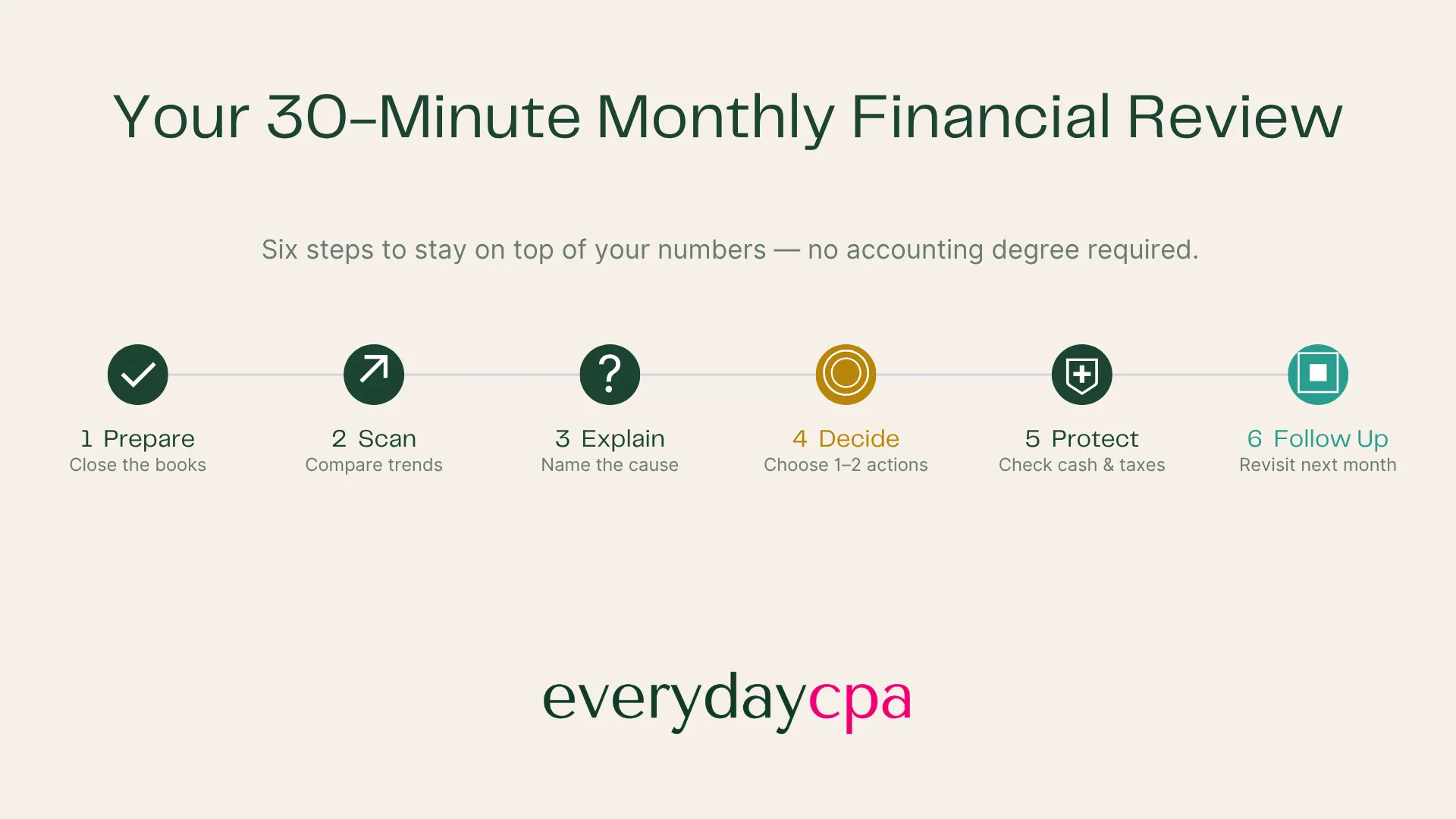
The 30-Minute Monthly Financial Review
Prepare: Close and reconcile the month. Confirm that the five metrics use consistent definitions.
Scan: Mark each metric as improving, stable, or weakening against the three comparisons.
Explain: Write one sentence for the biggest movement. Separate facts from assumptions.
Decide: Choose one or two actions, not ten. Name the owner and due date.
Protect: Check upcoming payroll, debt, vendor, and tax obligations against available cash.
Follow up: Put the action and expected result at the top of next month’s review.
Examples of useful actions include raising a price on one service line, changing a deposit policy, collecting three overdue invoices, canceling unused software, scheduling a tax estimate, or reviewing one client’s job profitability. ‘Watch expenses’ is not an action. ‘Reduce software subscriptions by $500 before the 20th’ is.
Do Not Forget the Tax-Reserve Overlay
Taxes are not one of the Vital 5 because the right reserve is highly specific to profit, entity type, owner compensation, location, prior payments, and other income. They still belong in every monthly conversation. The IRS describes federal income tax as pay-as-you-go and notes that many self-employed people and business owners may need estimated payments during the year.
Ask two questions: What is the current estimated tax obligation? Is the cash reserved for it actually set aside and available? A CPA can help translate accounting profit into a reasonable estimate for your situation. Do not apply a generic percentage without professional context.
When the Vital 5 Need Professional Interpretation
Call a CPA or qualified financial professional when the metrics disagree and you cannot explain why, margins move sharply, operating cash flow stays negative, receivables are aging, debt or tax obligations are becoming hard to cover, or the books are too unreliable to review. Also get help before a major hire, purchase, loan, pricing change, entity change, or owner-compensation decision.
Everyday CPA and iPacio are built around this distinction: reports record the past; CPA-led financial clarity helps an owner decide what comes next. You can explore how iPacio provides owner-focused reporting, monthly decision support, tax-ready records, and CPA review, or book a conversation with Kelly or Cat to talk through your business.
You Do Not Need More Numbers. You Need Better Questions.
The goal of a monthly financial review is not to admire a dashboard. It is to notice what changed while there is still time to respond.
Start with the Vital 5. Keep the definitions consistent. Compare each number with last month, last year, and the plan. Then ask what the business is trying to tell you. One clear action taken every month will do more for financial confidence than a folder full of reports no one uses.
Ready to turn your reports into decisions? Explore iPacio or book a call with Kelly or Cat.
Important: This article is general educational information, not personalized tax, accounting, legal, or financial advice. Metrics and appropriate actions vary by accounting method, industry, entity, jurisdiction, and individual circumstances. Consult a qualified professional about your situation.

FAQ: Monthly Financial Reviews
What financial metrics should a small business review monthly?
A strong starting set is revenue trend, gross profit margin, net profit margin, operating cash flow, and accounts receivable aging. Businesses with little receivables should substitute the working-capital metric most relevant to their model, such as inventory turnover, recurring revenue, backlog, or accounts payable due.
How often should a small business owner review financial statements?
Many owners benefit from a structured monthly review, supported by more frequent cash checks when liquidity is tight or the business moves quickly. Quarterly reviews may miss issues that need action sooner.
Why is cash flow different from profit?
Profit records revenue and expenses under the business’s accounting method. Cash flow records cash entering and leaving. Receivables, inventory, payables, loan principal, equipment, taxes, and owner distributions can create a large gap between the two.
Should I compare my metrics with industry benchmarks?
Yes, but use comparable companies and consistent definitions. Your own trend is often the first and most reliable benchmark. Industry averages can add context, but seasonality, size, geography, business model, and accounting policy matter.
Can QuickBooks or accounting software run this review for me?
Software can organize data, calculate ratios, and produce reports. It cannot reliably supply missing context, verify every classification, understand an owner’s goals, or decide which action fits the business. Accurate data plus informed interpretation creates clarity.